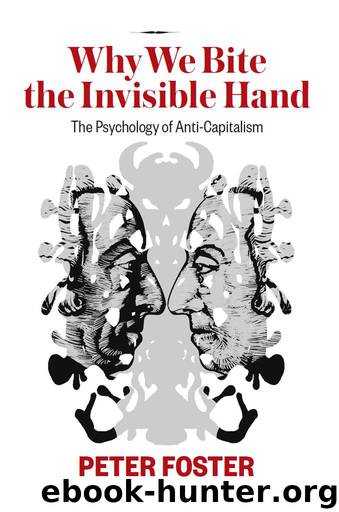
Why We Bite the Invisible Hand: The Psychology of Anti-Capitalism by Peter Foster
Author:Peter Foster [Foster, Peter]
Language: eng
Format: epub, azw3
Publisher: Pleasaunce Press
Published: 0101-01-01T00:00:00+00:00
One aspect of this debate that fascinated me was the part that wasn’t even debated or acknowledged: how rapidly evolving social arrangements — capitalism in particular — might render certain moral assumptions redundant or counterproductive, but how certain people or groups might hang on to those assumptions not just through inertia or because they were morally satisfying, but because they were adaptively useful.
Dawkins saw himself as part of a crusade against “viruses of the mind,” that is, “irrational” belief systems such as religion, but he appeared subject himself to one of the most pervasive of such viruses: a reflexive academic demonization of the capitalist “extended order” and those thought to be its champions. Dawkins’s mind had clearly been “occupied” by many left-wing mental viruses, such as a tendency to demonize the robber barons. As noted earlier, these “robbers” brought enormous good to society. Nevertheless, it has traditionally been regarded as the mark of intellectual sophistication and public concern on the left to ritually denigrate these great public benefactors.
“Rockefeller,” Dawkins told an interviewer, “an immensely rich and powerful man, had imported a form of Social Darwinism into his political beliefs. He really felt that the weak should go to the wall, and the strongest should survive; it was right in business, it was right in capitalism that the economically strongest and most ruthless should prevail.”
In fact, Rockefeller was a highly religious man and a renowned philanthropist, not to mention one of the greatest business geniuses of all time. His business competitors certainly found him “ruthless,” but his achievements included inventing the modern business organization and bringing cheap kerosene to the masses. Moreover, the important thing about capitalists is what they contribute in their area of business specialization and in their personal philanthropy, not what they think about how the wider world works, which can often be intellectually muddled or dangerously wrong, as in the case of Robert Owen and Friedrich Engels. More tendentiously muddled, however, was Dawkins’s reflexive equation of capitalist success with “ruthlessness” rather than prudence, organization and empathy with the consumer. As Matt Ridley pointed out, the great thing about emergent innovative markets was that by winnowing out bad ideas, they enabled more people to live and thrive. Such a view was simply inconceivable to those who demonized the market perspective.
In his book A Reason for Everything: Natural Selection and the English Imagination, Marek Kohn noted Dawkins’s reluctance to delve into the nature of morality, especially his own. Kohn pointed out that Dawkins had spent a couple of years teaching at Berkeley in California during the Hippie Sixties and had thrown himself into the politics of the time and place. “He was swept some way towards the left,” wrote Kohn, “and the tide did not bring him all the way back when it receded.”
Dawkins reportedly didn’t believe in the usefulness of field trips for zoology, so he didn’t believe they were necessary before making pronouncements on social arrangements. According to Kohn, “His politics are conducted similarly to his science.
Download
Why We Bite the Invisible Hand: The Psychology of Anti-Capitalism by Peter Foster.azw3
This site does not store any files on its server. We only index and link to content provided by other sites. Please contact the content providers to delete copyright contents if any and email us, we'll remove relevant links or contents immediately.
Rewire Your Anxious Brain by Catherine M. Pittman(18659)
Talking to Strangers by Malcolm Gladwell(13377)
The Art of Thinking Clearly by Rolf Dobelli(10496)
Mindhunter: Inside the FBI's Elite Serial Crime Unit by John E. Douglas & Mark Olshaker(9350)
Becoming Supernatural by Dr. Joe Dispenza(8226)
Change Your Questions, Change Your Life by Marilee Adams(7788)
Nudge - Improving Decisions about Health, Wealth, and Happiness by Thaler Sunstein(7712)
The Road Less Traveled by M. Scott Peck(7606)
The Lost Art of Listening by Michael P. Nichols(7510)
Mastermind: How to Think Like Sherlock Holmes by Maria Konnikova(7354)
Enlightenment Now: The Case for Reason, Science, Humanism, and Progress by Steven Pinker(7316)
Win Bigly by Scott Adams(7204)
The Way of Zen by Alan W. Watts(6621)
Daring Greatly by Brene Brown(6520)
Big Magic: Creative Living Beyond Fear by Elizabeth Gilbert(5780)
Grit by Angela Duckworth(5623)
Ego Is the Enemy by Ryan Holiday(5456)
Men In Love by Nancy Friday(5250)
The Laws of Human Nature by Robert Greene(5214)
